Powered By Blogger
Showing posts with label herbs. Show all posts

Friday, 15 July 2011

Using Oregano is Good


Oregano belongs to the mint family of plants. Besides culinary purposes, oregano can also be used for its medicinal properties. 

Here are some of its varied benefits... 

- Oregano leaves are a good source of manganese, iron and Vitamin A. Regularly eating these fresh leaves can help boost the immune system. 

- Thymol and carvacol compounds present in oregano are beneficial in aiding digestion and treating stomach upsets. Drink a glass of water with two to three drops of oregano oil for relief. 

- Oregano is known to relieve menstrual cramps. Chew a few leaves thrice a day to seek relief. 

- Severe cold and lung congestion can be treated using oregano oil. Add a few drops of this oil to a glass of water and drink for about three to five days. 

- Oregano oil contains antibacterial and antiviral properties, and is useful for treating skin infections. 

Thursday, 16 June 2011

Include fenugreek in your diet


Most commonly grown in the Mediterranean,Fenugreek or methi seeds are among the most popular herbs used today. Rich in vitamins and proteins that are excellent for your health, it also a favourite culinary ingredient. 

- Breastfeeding? Include methi seeds in your diet. They're known to increase milk production and stimulate breast tissue growth.

- Are you diabetic? Fenugreek seeds help lower blood sugar and reduce the need for insulin in the body.

- According to research, people with cholesterol problems can benefit from this herb. Fenugreek subdues the assimilation of cholesterol and lowers the amount that is manufactured by the liver.

- Experts say that Fenugreek helps induce labour, treat hormonal disorders and reduce menstrual pain to a certain extent.

- For skin inflammations like abscesses, boils, burns, cuts, eczema, and gout, Fenugreek is a big help. It works as an effective topical treatment for skin problems. 

Tuesday, 7 June 2011

Fresh summer herbs


Basil: Closely related to mint, basil has a floral flavor and aroma. There are two main types of basil: Sweet/Italian basil and Asian/Thai basils. Sweet basil pairs naturally with tomatoes, eggplant, and other Mediterranean cuisine, but is versatile and goes well with many dishes.  but it can be used with almost every type of meat or seafood. Asian basil has a more distinct flavor and is often used in curry  and stir fry.
Parsley: With a light peppery flavor, parsley goes well with many flavours. It’s most often used for colour and freshness. There are two main varieties: flat-leaf or Italian parsley is best for texture and flavor. Curly parsley is best as a garnish.
Cilantro: Also called coriander, this herb has a bright, refreshing flavor. You love it or you hate it, but it’s a staple of Latin and Asian cooking, and a key in guacamole and Indian curry.
Oregano: This herb is primarily found in Mediterranean and Mexican cuisines, it actually is often more flavorful as dried. It is also handy to have on hand, as it can be used as a substitute for marjoram..
Mint: Its cooling, peppery taste is great for savory dishes, especially summery salads and calming teas. Use it to garnish your favourite desserts, too.
Rosemary: This woody herb has a strong flavor, so use sparingly. It’s a great complement to roasted potatoes, or used as flavor in soups and marinades.
Thyme: Delicious with a simple flavor, this herb can be used in nearly all types of cooking and all vegetables and meats. To use fresh thyme, run your fingers along the stem to remove the leaves, then chop well.
Dill: The fronds of the dill plant have a subtle, yet distinct taste, great with seafood and vegetables.  It perishes quickly, in about 3 days, so only cut what you need.

Handling and Storing

So after we plant them, how do we keep care of them? Some can be pre-washed, but others should wait until just before use. Large-leaved herbs such as basil and Italian parsley can be washed refrigerated in a plastic bag with a dry paper towel. To elongate their life, stand them on end in a glass of cold water, and cover with a plastic bag. Herbs such as parsley, mint, and cliantro can last up to two weeks this way.

Tuesday, 26 April 2011

How to Grow Mint


Given half a chance, mint will take over your whole garden. That natural vigor makes this hardy perennial a great, no-fail plant for beginning gardeners - or for anyone who needs a tough, fast-growing and lovely ground cover.

Instructions


things you'll need:


  • Garden Trowels
  • Mint Plants
  • Planting Containers
  • Potting Soil
  • Clay Drainage Tiles
    • 1

      Choose a site where mint can roam freely without disturbing other plants in your garden. It's happiest in partial shade and in moist, moderately rich, slightly acid soil, but it will grow in any light from full sun to full shade and in any kind of soil you happen to have.
    • 2
      Buy mint plants at the nursery for planting in early spring, as soon as the ground can be worked. (Mint does not grow well from seed.)
    • 3

      Plant mint in its ideal conditions if you want a vigorous ground cover. To contain its enthusiasm, give it a less-than-perfect home (for instance, full sun and soil that's on the dry side).
    • 4
      Set plants 12 to 18 inches apart, depending on the variety. To control their rampant ways, plant them in bottomless containers sunk into the soil. Clay drainage tiles, about 10 inches deep and 6 to 8 inches across, are ideal.
    • 5

      Keep the soil moist until the plants are established.
    • 6

      Pinch stem ends off each spring to keep plants bushy. At the end of the gardening season, prune plants back to near ground level and top-dress with compost.
    • 7
      Harvest sprigs as you need them throughout the growing season.

Growing Area

  • The area in which a mint plant grows inside plays a major role in its health. Plants grown without access to natural light or a comparable artificial grow lamp may produce brown, unhealthy mint leaves and be more susceptible to pest and disease problems. Keep the mint plant where it receives an adequate amount of light during the day to keep it healthy and green; mints grow best in full light or partial shade.

Pests

  • Pest problems can lead to the formation of dead spots on the leaves of a mint plant that become brown or black as the mint plant is weakened. Scale insects, aphids and spider mites are pests that affect indoor houseplants and feed on the leaves, which stops the mint from producing nutrients properly. Apply a mild pesticide or insecticidal soap to the mint plant according to the directions to keep the mint plant healthy.

Anthracnose

  • Anthracnose is a fungal disease that can affect mint plants. It causes small black or swollen spots to appear on the leaves of the mint plant, and the leaves will eventually die if the plant remains untreated. Prune healthy plants in the fall to prevent the disease from spreading and using the plant as a winter host, and remove affected leaves from sick plants to stop the anthracnose from producing spores. Keep the mint's planter drained.

Mint Rust

  • Mint rust is a disease that affects mint plants by creating reddish brown spots on the underside of the leaves and infecting the stems of the plant. Eventually, the mint plant will experience leaf loss as the fungus produces spores and kills off the leaves. Apply fungicides that contain the chemical chlorothalonil to the mint plants to kill the fungal spores and stop the disease from spreading; follow all directions on the fungicide for the best results.
Uses for Mint
How to Grow MintFor a healthy way, Mint, especiallyPeppermint has been known to cure problems such as Nausea, indigestion and even heartburn.
How to Grow MintApple Mint is used for juices and ice tea. Also you can create the famous alcoholic cocktail, Mojito's with crushed Mint.
How to Grow MintGinger Mint is delicious with salads.
How to Grow MintPineapple Mint helps along a cheese and cracker plate.

Propagation
Mint is sold at most garden centres in small pots - as long as they are purchased after all danger of frost has passed, they can be planted straight outside.
Mint has shallow, creeping roots which can be broken off and placed either directly in the ground or in pots containing potting compost. Because mint is such a strong-growing plant, it can easily kill nearby plants. The solution when planting outside is to sink a bottomless container, such as an old bucket, in the ground and plant the mint in this area. The roots might not be stopped 100%, but it will do the job. Another alternative is to dig a hole to a depth of 30cm (1ft) and line it with black plastic (pierced with small holes for drainage). The soil is then replaced in the black plastic and the mint planted in that area. 
Care of Mint
Mulching the soil will go a long way to keeping mint happy - it will achieve the all important job of keeping a moist root run which mint likes so much. A twice yearly feeding with bonemeal will keep it even happier. Remove the flowers by hand as soon as they appear because if left, they will reduce the amount of leaves. There is very little else to do except enjoy it.
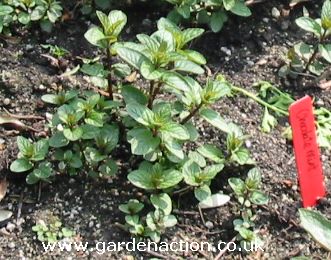
Chocolate mint
Mint suffers from only one disease and that is rust - allow it to get a hold and it will kill all your mint plants. There are chemical sprays for rust, but they can often be only a part solution. The best method is to examine each plant carefully for signs of rust (orange blobs generally on the underside of the leaves) and remove any leaves affected - spray as well with a chemical if you want. If this does not remove the infection chop the plant down to ground level and burn it all - drastic, but the only cure in the late stages of rust infection.

Recommended Mint Varieties
Spearmint Mentha spicata - a traditional mint for mint sauces. A strong grower with attractive dark green leaves.
Alpine Mint Bush Prostanthera cuneata - try something different, mint leaves with pure white flowers, a herb with true beauty.
Chocolate Mint - really does taste a bit like mint chocolate!. A novelty worth a try?