Powered By Blogger
Showing posts with label gardening. Show all posts

Thursday, 26 May 2011

Marshmallow


Marshmallow (Althea officinalis) -- the herb, not the white puffy confection roasted over a campfire -- has been used for more than 2,000 years as both a food and a medicine. The Romans, Chinese, Egyptians, and Syrians used marshmallow as a source of food, while the Arabs made poultices from its leaves and applied them to the skin to reduce inflammation. Both the root and leaves contain a gummy substance called mucilage. When mixed with water, it forms a slick gel that is used to coat the throat and stomach to reduce irritation. It is also applied topically to soothe chapped skin.
Very few scientific studies have looked at the effects of marshmallow in humans. Most of its suggested uses come from a long history of use in traditional healing systems.
  • Asthma
  • Bronchitis
  • Common cold/sore throat
  • Cough
  • Inflammatory bowel diseases such as Crohn's disease and ulcerative colitis
  • Indigestion
  • Stomach ulcers
  • Skin inflammation

Herb Description

Marshmallow ( Althea officinalis )-the herb,has been used for centuries as both a food and a medicine. Its botanical name comes from the Greek word "altho," which means "to cure." The Romans, Chinese, Egyptians, and Syrians used marshmallow as a source of meal,To reduce inflammation on the skin Arabs used its leaves & applied on external areas. Marshmallows are incredibly cool not because of its good taste, but also a good source of light, just lighting them you can create a great light in a dark campsite.Due to exceptional healing properties it has been used by herbalists for many centuries to heal a range of ailments, hence its botanical name, Althea officinalis, from the Greek altho, meaning 'to heal'.
Mallows & there family grows largely in the tropical region, where they form a large proportion of the vegetation; towards the poles they gradually decrease in number. Besides the medicinal virtues of so many species, some are employed as food; the bark of others affords a substitute for hemp; the cotton of commerce is obtained from the seed vessels of yet other species, and many ornamental garden flowers are also members of this group.
Both Marshmallow root and leaf are medicinal teas. The root is used as medicine to prepared cough tea and cough syrup medicines In the United States, marshmallow is used as a component of dietary supplement antitussive and demulcent preparations .

Uses and Benefits

Marshmallow is used to cure following problems:
  • Asthma
  • Bronchitis
  • Common cold/sore throat
  • Cough
  • Inflammatory bowel diseases such as Crohn's disease and ulcerative colitis
  • Stomach ulcers
  • Weight loss aid (marshmallow swells with fluid and gives a sense of fullness)
  • Wound healin
Marshmallow is excellent for the skin. If applied externally it shows fantastic moisturizing and nourishing properties and is used to soothe and repair dry and cracked skin.
Marshmallow contains anti-inflammatory effect, Marshmallow is very good for problems with the urinary system, including .cystitis, urethritis, urinary gravel and calculus. 
Marshmallows leaf if used internally cure the irritation of the oral and pharyngeal mucosa and associated dry cough.
Root of Marshmallow use in :
  • Demulcent
  • diuretic
  • emollient
  • vulnerary.
Leaf of Marshmallow use in :
  • Demulcent
  • expectorant
  • diuretic
  • emollient
  • antilithic.
Flowers of Marshmallow use in :
  • expectorant

Side Effects

Not recommended during pregnancy .
Don't take medicine if it shows following symptoms which may mean you are allergic to it.The right away is to talk to your doctor.
  • Breathing problems.
  • tightness in your throat.
  • Chest pain .
  • Skin hives.
  • rash.
  • itchy.
  • swollen skin .
  • tightness in your chest .

Dosage

As a dietary supplement take 1-3 ml. (approx. 28-84 drops), 3 times a day
  • Leaf fluid extract: ¼ to ½ tsp (1:1 g/mL),2-3 times daily
  • Leaf tincture: 1 to 2 tsp (1:5 in 25% ethanol), 2-3 times daily
  • Root infusion or cold-water maceration (2% to 5%): 5 ounces (1 to 2 tsp) taken to soothe cough and sore throat
  • Dried root: 2 to 6 g or equivalent preparations daily (cold infusion 3 times per day)
  • Marshmallow cough syrup (from root): 2 to 10 g per single dose
Unless otherwise prescribed: 5 g per day of cut leaf.
Infusion: 1-2 g in 150 ml boiled water, two to three times daily.
Cold maceration: 1-2 g in 150 ml cold water for 60 minutes stirring occasionally; strain and warm before drinking, two to three times daily.
Fluidextract 1:1 (g/ml): 1-2 ml, two to three times daily.
Tincture 1:5 (g/ml): 5-10 ml, two to three times daily.
For Adults (18 years and older) in skin inflammatory conditions (eczema, psoriasis): Applied, 5-10 grams of marshmallow in ointment or cream base or 5% powdered marshmallow leaf to the skin three times daily. Daily oral doses of 5 grams of marshmallow leaf, or 6 grams of marshmallow root have been suggested by mouth. Oral and pharyngeal irritation: A dose of 2 grams of marshmallow in 1 cup of cold water, soaked for 2 hours then gargled has been used.
Children (younger than 18 years) There is not enough record scientific data to prescribe marshmallow for use in children.

Drug Interactions

Don't take marshmallow along with other herbs or medications because it may interfere with the absorption of certain medications .So it is important to take marshmallow several hours before or after ingesting .
Marshmallow is generally safe with only rare allergic reactions reported.

Oral marshmallow preparations may interfere with the absorption of drugs or other herbals in the body. Because it coats the gastrointestinal tract.


Fenugreek - Uses and Benefits


Alternative Names:

Fenugreek,Greek hay, Foenugreek, 

Herb Description

Fenugreek is an annual herbaceous plant deep-rooted to Asia & southern Europe . It is one of the oldest cultivated herb, fenugreek is widely found presently in the Mediterranean countries, Argentina, France, India, North Africa, & the United States as a medicinal, food, condiment, dye, & eat age plant. Fenugreek is normally famous as safe for human consumption as a spice and as a plant extract . It is also known as Methi or Classical Fenugreek , is a crop plant produced as a potherb . It is an erect herb, mature to be about 2 feet tall. It White flowers blooms in the summer and develop into long slender green pods. Mature brown pods have 20 tiny yellow aromatic seeds.The fenugreek seeds contain high amount of the polysaccharide galactomannan . The diamond like seeds are irregularly rounded, about 3 -5 mm long and 2-3 mm thick and wide.
It is a food that has been used safely for thousands of years as a common ingredient of curry.The fenugreek seed is usually taken in the preparation of curry powders , pickles, & pastes, and is generally used in the cuisine of the Thailand & Indian subcontinent. Egyptians use fenugreek roasted seeds and use them as coffee. The fresh leaves and sprouts of fenugreek are consumed as greens & the fresh or dried leaves are used to flavor other dishes. The dried leaves have a bitter taste and peculiar, not unlike lovage or celery and a strong characteristic odor which means they need to be taken sparingly. Fenugreek is normally used in the food industry as an artificial maple flavoring.

Uses and Benefits

Externally fenugreek is used for boils, eczema ,skin inflammations, ulcers, and cellulite . Internally fenugreek is used to treat numerous problems such as gastric inflammation,diabetes in adults , poor digestion, digestive disorders & tuberculosis. It is also beneficial for painful menstruation, labor pains and insufficient lactation. It is also efficacious treatment for painful testicles and premature ejaculation . It is generally taken for weight loss, anorexia & for appetite loss. Young fenugreek leaves are cooked as a vegetable curry and are also dried and used to flavor vegetable dishes. The roasted seeds are use in curry powder, pickles, stews and fried foods. The seed sprouts are also used as a salad.

In Ayurvedic medicine it is commonly used for digestive,rejuvenation ,bronchial complaints, gout ,arthritis and as an aphrodisiac. In Chinese medicine it is widely used for the treatment of kidney related pain such as premature ejaculation,back ache, as well as loss of libido, painful testicles, hernia, painful menstruation & edema of the legs
Now a days ,The fenugreek seeds are used to large extent in the manufactures of condition powders for cattle & horses . It has a powerful smell of coumarin and is widely used for flavoring cattle foods and to make damaged hay palatable.
Its seed has been taken to enhance milk production since biblical periods. The plant retains phytoestrogens, which are herbaceous chemicals similar to the female sex hormone estrogen. Diosgenin, a main compound, has been shown experimentally to enhance milk flow .

Side Effects

The herb fenugreek has produced aggravated asthma disorders in some women and has lowered blood glucose levels in some women with diabetes. Person using oral drugs for diabetes or taking insulin should be closely monitored by a doctor while using fenugreek.
Few side effects have been reported from exposure to fenugreek, such as numbness,facial swelling, breathing difficulty and fainting are likely a cause of an allergic reaction. Some side effects may occur such as dizziness, diarrhea and gas when fenugreek is used at recommended doses.
Fenugreek may cause loose stools in some women, can produce uterine contractions ,hypoglycemia in some mothers ,sweat and urine smells like maple syrup , since it can produce lowering of blood glucose levels so it is recommended to diabetic mothers should not use fenugreek without consulting any health care professional.

Dosage

Usual daily dosage:
  • 1 - 2 gm. Take three times a day.(For general health )
  • 50 gm. Take twice a day.(For type 1 diabetes )
  • 2.5 gm of seed powder . Take three times a day.( For type 2 diabetes)
Tea:
  • Drench 0.5 gm of crushed seed in 1 cup of cold water for 3 hours. Strain 5 min before drinking. Drink 3 times a day
     

Drug Interactions

Fenugreek should be taken at least 2 hours before or after any prescription drug because it may interfere with the absorption of other drugs that are taken orally.
Fenugreek may heighten the risk of bleeding when taken with anticoagulants (blood thinners) or antiplatelet drugs such as warfarin , heparin and clopidogrel .

Growing Fenugreek


Fenugreek (Trigonella Foenum-Graecum) is an annual indigenous to the Mediterranean and grown widely in Europe and Asia. It has a long medicinal history, and is recommended for cleansing the chest and lungs in Culpepper's Herbal of 1649.

Planting Fenugreek

Fenugreek grows to about two feet (60cm), with yellow/white flowers and long yellow seedpods. It likes full sun and well-drained, neutral to slightly acid soil. It doesn't like to be transplanted. In spring, after the threat of frost has passed, sow seeds to a depth of a little less than a quarter inch. The seeds sprout quickly. Unlike many other herbs that thrive on neglect, fenugreek likes fertile soil, so be generous with the compost. Space plants five to six inches apart.

In New York City recently, the aroma of fenugreek created a cloud of mysterious maple fragrance which was traced to a nearby manufacturing plant. Your garden can smell like maple too.

Harvesting Fenugreek Seed Pods


Harvest and dry seedpods in early to mid fall, and store them in an airtight container in a dry, dark spot.

Using Fenugreek as an Herbal Remedy

Fenugreek can be taken internally or used topically. It is most often used to treat coughs and sore throat, although current research suggests that it may be effective in the treatment of Type 2 diabetes, can help lower blood cholesterol, and increase circulation. It is also often recommended as an herbal treatment for tinnitusFor more information on possible uses for fenugreek, visit: Fenugreek as an Herbal Remedy

Other Uses for Fenugreek

It is a common ingredient in curries and imitation maple syrup. It can also be used as a dye.

Fenugreek Aphrodisiac

Fenugreek usually makes the short list of sexual stimulant herbs, and has been used with some success in treating male impotence. It's thought that Fenugreek's ability to help improve circulation is the cause.

In women, fenugreek may also help in treating vaginal dryness.


Tips on Growing Chamomile and its Benefits

German Chamomile (Matricaria recutita)German Chamomile growing in the garden.
An erect annual (Matricaria recutita),with small, daisylike flowers, is used to make chamomile tea and posessing a number of medicinal qualities.

German Chamomile seeds are one of the few seeds that need light to germinate, so starting them by seed is a delicate process. It is best planted outdoors in August by broadcasting the seed and mixing very lightly with the soil. Alternatively, they can be started indoors in propagation flats in March and transplanted outdoors after a hardening off period. In most cases, direct planting in the garden after all chance of frost has passed are successful, as well. Once they are firmly established, German Chamomile is extremely hardy.

Chamomile tea can be sprayed on propagation flats to prevent damping off. It is also believed to increase the absorption of calcium when added to a compost pile.


Growing German Chamomile

Growing CulturesOutdoors, containers, landscaping, mass plantings. German chamomile not recommended for containers.
Plant HeightChamomile grows to a height of 20 to 30 inches (50 - 70cm).
Plant SpacingChamomile plants should be spaced 6 inches (15 cm) apart.
Preferred pH Range
Chamomile will grow in a relatively wide pH range between 5.6 (acidic) and 7.5 (neutral).
Propagation
From seed. Direct sow in spring or fall. Fall sown seeds germinate following spring. Seeds need light to germinate.
Seed Germination Period7 to 14 days.
Seeds Per Gram (Approximate)10,000 to 18.000.
Soil Requirements
Well drained, poor to average soil.
Alternative Growing Media
Soilless potting mixes, perlite, vermiculite, rockwool, coco peat, Oasis foam.
Time From Seed to Saleable PlantSeeds to finished plugs, 6 weeks; plugs to saleable plants, 6 to 6 weeks.
Sun & Lighting RequirementsChamomile grown outdoors prefers full sun but will tolerate some shade.
Chives will grow indoors satisfactorily under standard fluorescent lamps, and exceptionally well under high output fluorescent , compact fluorescent, or high intensity discharge (metal halide or high pressure sodium) plant growing lights. Keep standard fluorescent lamps between 2 and 4 inches from the tops of the plants, high output and compact fluorescents approximately one foot above the plants, and HID lights between 2 and 4 feet above the plants, depending on wattage. Have an oscillating fan gently stir seedlings for at least 2 hours per day to stimulate shorter, sturdier, and more natural plant habit.
USDA HardinessAnnual.
Water RequirementsWater on a regular schedule, taking care to not overwater.
Potential Pests & DiseasesAphids, mealybug. Minimal disease issues.
Special NotesChamomile may be considered a noxious weed or invasive plant in some areas. Chamomile is known to attract bees, butterflies or birds and has fragrant blossoms. Chamomile self-sows freely; remove flowers (deadhead) if you do not want volunteer seedlings the following season.


Chamomile - Uses and Benefits

Alternative Names:
Feldkamille,Camomile, Chamomile,Fleurs de petite camomille, Wild Chamomile, Sweet Chamomile, German Chamomile, Hungarian Chamomile, Mayweed, Scented Mayweed, Pineapple Weed , Fleur de camomile, Flores Anthemidis.

Herb Description

Chamomile ( Anthemis nobilis ) is an annual herb originally from Europe which has escaped to the wild and is now grow on almost every part of world.The chamomile word is derived from the Greek chamos "ground" and melos "apple", referring to the low growing plant and the fact that the fresh flowers are somewhat apple like aroma.It can now be found maturation along fence rows, roadsides & fully sun light open areas from Southern Canada to Northern U.S. west to Minnesota.
It is a low height plant, crawling or trailing, its tufts of leaves and flowers are one foot high.The root of this small herb are jointed and fibrous, the stems, hairy & freely branching, are covered with leaves which are dichotomy into thread-like segments, the fineness of which gives the whole plant a feathery appearance.It flowers in July to September and are borne solitary on long, erect stalks, drooping when in bud.The leafage is feathery with an apple aroma , and it is accented by white, daisy-like flowers with down-turned petals.
Chamomile is considered one of the oldest garden herbs with medicinal property & used by the ancient Egyptians as a universal remedy for the treatment to promote calm and relieve anxiety at bedtime. Chamomile is naturally caffeine-free & used as a herbal tea in many parts of the world.It flowers are eatable and quite tasty in salads or used into a refreshing cold or warm beverage. It is useful in the treatment of asthma and hay fever as it contains anti-allergenic property.

Properties

  • Analgesic.
  • Antibacterial.
  • Antiseptic.
  • Digestive Stimulant.
  • Anti-inflammatory.
  • Sspasmolytic.
  • Vulnerary.
  • Antimicrobial.
  • Mild sedative.
  • Carminative.
  • Anticatarrhal.

Uses and Benefits

Chamomilla  are widely used to alleviate morning sickness, mastitis, menopausal symptoms, dysmenorrhoea, amenorrhoea with a psychological component & hysteria .Internally it is used to treat to treat inflammation & spasms of the digestive tract. As a mouth rinse, it's taken for sore gums and oral inflammation.  
As a remedy chamomile is used for various disorders such as Bronchitis ,Colds ,Cough ,Fever ,Skin inflammation ,Sore throat ,Tendency to infection ,Wounds and burns . Chamomile is use to ebb & relaxes at bedtime,relieves restlessness, teething problems, and colic in children,relieves allergies, relieves morning sickness during pregnancy,speeds healing of skin ulcers, wounds, or burns,treats gastritis and ulcerative colitis.
Products made from chamomile are widely used as anti-inflammatory, antibacterial, antispasmodic, and sedative property.Its extracts are used to ease pain and irritation, clean wounds and ulcers, and aid irradiated skin injuries, as well as cure cystitis & dental afflictions . The tea has anti-inflammatory actions,beneficial for rheumatism, arthritis, and other painful swellings.
Scientist recommended chamomile as medicine or therapy to treat various problems such as allergies, arthritis, boils, colic, cuts, cystitis, dermatitis, dysmenorrhea, earache, flatulence, hair, headache, inflamed skin, insect bites, insomnia, nausea, neuralgia, PMS, rheumatism, sores, sprains, strains, stress, wounds,acne ,blisters ,depression ,digestive problems ,gout ,indigestion ,irritable bowel syndrome ,nervous tension, eczema & psoriasis.

Dosage

  • Tea:
Take 1 cup boiling water add 2 teaspoon of dried flowers & steep covered for 10 to 15 minutes. Use three times in a day.
  • Liquid Extract:
1:1 in 45% alcohol, 1-4ml . Use three times in a day.
  • Tincture:
1:5 in 45% alcohol, 3-10ml. Use three times in a day.

Drug Interactions

Chamomile have tranquilizing properties which could add to the blood-thinning effect of Coumadin & similar drugs.It is recommended not to use with alcohol & anti-anxiety drugs such as Valium,Ativan, and Xanax.
Chamomile may heighten the level of drowsiness caused by some drugs such as benzodiazepines, ativan, barbiturates & phenobarbital.


Parsley - Uses and Benefits


Alternative Names:
Petroselinum crispum

Herb Description

Parsley is one of the best known and most widely used culinary herbs and it has been cultivated for more than 2,000 years.This herb is native to Lebanon, southern Europe and Algeria . It takes its name from the Greek word meaning "rock celery" (parsley is a relative to celery).It is actually a biennial plant, but is usually planted as an annual because the first year leaves have the best flavor. The use of curly leaf parsley is mostly favored, because it can not be confused with poison hemlock like flat leaf parsley or chervil . parsley was used medicinally prior to being consumed as a food.
Parsley is available in two types: a curly-leaf type, which has a mild taste, and a flat-leaf type, known as Italian parsley and has a more pronounced pungency than the curly-leaf variety. Parsley is one of the most widely known herbs The leaves contains vitamin C, vitamin A, iron and essential, aromatic oils in good amount. Parsley leaves and seeds are commonly used in cooking.

Uses and Benefits

Parsley used to control high blood pressure also used as an emmenagogue. It relieve from period pain and menstrual irregularity, as well as rheumatism.Due to its diruretic properties, its root play great service in gravel, stone, and jaundice.
Raw parsley clear the blood, dissolves sticky deposits in veins, maintains the elasticity of blood vessels, facilitates removal of moderately sized kidney & gallstones,good to treats deafness and ear infections, and benefits the sexual system.If there is bad breath ,chewing parsley prevents from it.

Parsley helpful in : diuretic ,removing excess water from the body,slimming ,detoxifies ,boosting kidneys ,gout and arthritis ,contracting the uterus after childbirth ,menstrual pain ,period irregularity .
Its traditional benefits are: Congestion , Culinary , Depression & Rheumatoid Arthritis
Parsley root is more generally prescribed than the seeds or leaves in herbal medicine. It is used as a treatment for flatulence, cystitis and rheumatic conditions. Parsley is also helpful as a promoter of menstruation, being works well both in stimulating a delayed period and in relieving menstrual pain.

Side Effects

People having untreated kidney or gallbladder problems may want to avoid eating parsley .Parsley may lead the risk of bleeding or potentiate the effects of warfarin therapy.It may cause some sort of internal reaction due to skin allergy.
Parsley is one of the foods that contain measurable amounts of oxalates, naturally-occurring substances found in plants, animals, and human beings. When oxalates become too concentrated in human body fluids, they can crystallize and cause health problems.
During pregnancy use of parsley seed not recommended because it may uterine bleeding and cause muscle contractions in the uterus. Some studies reported occasional allergic skin or mucous membrane reactions .
Parsley oil is toxic in nature so should not be used in isolation . Using high doses of Parsley oil or preparations rich in the oil can be poisonous .Symptoms of poisoning are increased contractions of the bladder, intestines and uterus. Other side effects include excessive weight loss, nosebleeds, kidney shutdown,bloody stools.

Dosage

Fluid Extract : 2 ml 3 times daily.
Prescribed dose :crushed herb and root 6 gm daily .
Infusion: 2 gm in 150 ml water, 3 times daily.

Drug Interactions

None known.

Medicinal Uses of Parsley
Parsley is a vitamin and mineral powerhouse, and as such should be part of every medicinal garden.  Indoors, it adds greenery and makes an attractive, edible garnish for the kitchen shelf during the winter.  Outdoors, it can be planted with other herbs or flowers, and makes a pretty, green accent.  

Parsley contains a large amount of chlorophyll, and as such is a natural breath sweetener.  Eat the leaves right off the plant to combat breath odors.  
Throughout history, Parsley Teas have been used mainly as kidney stone, bladder infection, and jaundice medications, as well as digestive aids.   The root appears to be more effective than the leaves, but leaves can also be used. Leaves can be dried, pulverized into a powder, and inserted incapsules, if desired.  See the link below for more information.  Pregnant women should avoid all but small quantities of Parsley because it can be irritating to the kidneys.  
Externally, make an Oil of Parsley leaves and roots to repel head lice, and try making an Ointment for use on swellings.  Pound the leaves into a paste and mix with a little water or tea to use on skin for easing symptoms from bug bites and stings. A little oatmeal can be added to this mixture for better consistency.   Try dipping a cloth in unsweetened tea and place over closed eyes for 10 minutes to reduce fatigue and swelling of the eyes


Tips on Growing Parsley


ParsleyPotted Italian Parsley
Parsley
A biennial herb (Petroselinum)grown as an annual. Its many horticultural varieties are grouped as curled leaved (var. crispum), fernleaved (var. filicinum) and Hamburg or "rooted" (var. radicosum). Though the leaves of all are used for flavoring meat dishes, soups, salads, etc., the curled varieties are most popular in America for this purpose and for garnishing, though the fern-leaved are just as attractive. Hamburg Parlsey is generally cooked like parsnips.


As parsley seed germinates slowly (sometimes taking several weeks), it should be soaked in warm water overnight before planting. Sow outdoors in early spring in rows 10 to 12 inches apart, and cover 1/2 inch deep. Later thin the plants to stand about 6 inches apart.

The leaves may be cut all season for use as needed. In the fall they may be dried and stored in tight jars, or roots may be transplanted into pots or hydroponic planters to be grown on indoors. The following spring remove the flower stems as fast as they appear so as to keep the plants producing leaves until those grown from a newly sown crop are ready.
Parsley grows well in a deep pot, which helps accommodate the long taproot. Parsley grown indoors requires at least five hours of sunlight a day.

Parsley grows well in loamy garden soil rich in nitrogen, and does well in full sun or part shade. Parsley can overwinter if lightly mulched during extremely cold weather.

Growing Parsley

Growing CulturesOutdoors, containers, hydroponics.
Plant HeightParsley plants grow to a height of 12 to 18 inches (30 - 45cm).
Plant SpacingParsley plants should be spaced 9 to 12 inches (22 - 30cm) apart.
Preferred pH Range
Parsley will grow in a pH range between 5.6 (acidic) and 7.5 (neutral) with a preferred range between 6.0 and 7.0.
Propagation
Sow indoors in sunny location or under plant grow lights six weeks before last frost.
Seed Germination Period21 to 28 days.
Seeds Per Gram (Approximate)650 to 1,000.
Soil Requirements
Tolerates most soils, but rich, well-drained, moist, with a pH between 6 and 7 is best.
Alternative Growing Media
Soilless potting mixes, perlite, vermiculite, rockwool, coco peat, Oasis foam.
Time From Seed to Saleable PlantSow in plugs or direct in pots, 4 to 5 seeds per plug or 12 seeds per pot. Seeds to finished plugs, eight weeks. Plugs to saleable plants, six weeks.
Sun & Lighting RequirementsParsley grown outdoors prefers full sun and can tolerate some shade.
Parsley will grow indoors satisfactorily under standard fluorescent lamps, and exceptionally well under high output fluorescent , compact fluorescent, or high intensity discharge (metal halide or high pressure sodium) plant growing lights. Keep standard fluorescent lamps between 2 and 4 inches from the tops of the plants, high output and compact fluorescents approximately one foot above the plants, and HID lights between 2 and 4 feet above the plants, depending on wattage. Have an oscillating fan gently stir seedlings for at least 2 hours per day to stimulate shorter, sturdier, and more natural plant habit.
USDA Hardiness5a to 9b.
Water RequirementsAverage water needs. Water on a regular schedule, do not overwater.
Potential Pests & DiseasesWhitefly, spider mites, aphids. Minimal disease issues.
Special NotesGrown for aromatic foliage. Suitable for containers.


Growing Parsley....2
 Growing Parsley can be slightly more of a challenge when compared to growing other herbs but it should still be a relatively simple process. Parsley is one of the most popular herbs that are grown in english and mediterrenean herb gardens. Parsley can be used for flavouring or as a garnish. It is also a good source of nutrition and can be used for neutralising strong smelling breath (Garlic springs to mind). 

Although Parsley is a biennial herb it is normally grown as an annual as results after the first year are poor.


Sowing

Growing parsley requires more patience than other herbs as it has a long germination period - around 3 to 4 weeks. Germination of parsely requires warm temperatures so a warm room is advised rather than outside. Because germinating parsley is trickier than most herbs you may wish so station sow a number of seeds in a 4 inch pot in case some seeds don't germinate. If a number of seeds germinate in one pot thin all but the strongest one seedling.

Parsley can be moved outside if required and can be transplanted into containers or well dug soil. If growing outside then sow your plants indoors about 6 to 8 weeks before you plan to move them outside.

Position

Parsely requires a good amount of light and will do best when receiving around 6 hours of sun a day but will tolerate partial shade.

Soil type

Parsley likes a well drained, moisture retaining soil. If growing in containers ensure that it has adequate drainage holes and that they aren't blocked. Parsley is slightly more fussy about its soil requirements than most herbs, a soil rich in rotted organic matter with good levels of nutrients will result in a good crop.

Parsley will grow well in a soil that is pH 6.0- 7.0

If growing indoors then a normal potting compost will be sufficient.


Tuesday, 26 April 2011

How to Grow Mint


Given half a chance, mint will take over your whole garden. That natural vigor makes this hardy perennial a great, no-fail plant for beginning gardeners - or for anyone who needs a tough, fast-growing and lovely ground cover.

Instructions


things you'll need:


  • Garden Trowels
  • Mint Plants
  • Planting Containers
  • Potting Soil
  • Clay Drainage Tiles
    • 1

      Choose a site where mint can roam freely without disturbing other plants in your garden. It's happiest in partial shade and in moist, moderately rich, slightly acid soil, but it will grow in any light from full sun to full shade and in any kind of soil you happen to have.
    • 2
      Buy mint plants at the nursery for planting in early spring, as soon as the ground can be worked. (Mint does not grow well from seed.)
    • 3

      Plant mint in its ideal conditions if you want a vigorous ground cover. To contain its enthusiasm, give it a less-than-perfect home (for instance, full sun and soil that's on the dry side).
    • 4
      Set plants 12 to 18 inches apart, depending on the variety. To control their rampant ways, plant them in bottomless containers sunk into the soil. Clay drainage tiles, about 10 inches deep and 6 to 8 inches across, are ideal.
    • 5

      Keep the soil moist until the plants are established.
    • 6

      Pinch stem ends off each spring to keep plants bushy. At the end of the gardening season, prune plants back to near ground level and top-dress with compost.
    • 7
      Harvest sprigs as you need them throughout the growing season.

Growing Area

  • The area in which a mint plant grows inside plays a major role in its health. Plants grown without access to natural light or a comparable artificial grow lamp may produce brown, unhealthy mint leaves and be more susceptible to pest and disease problems. Keep the mint plant where it receives an adequate amount of light during the day to keep it healthy and green; mints grow best in full light or partial shade.

Pests

  • Pest problems can lead to the formation of dead spots on the leaves of a mint plant that become brown or black as the mint plant is weakened. Scale insects, aphids and spider mites are pests that affect indoor houseplants and feed on the leaves, which stops the mint from producing nutrients properly. Apply a mild pesticide or insecticidal soap to the mint plant according to the directions to keep the mint plant healthy.

Anthracnose

  • Anthracnose is a fungal disease that can affect mint plants. It causes small black or swollen spots to appear on the leaves of the mint plant, and the leaves will eventually die if the plant remains untreated. Prune healthy plants in the fall to prevent the disease from spreading and using the plant as a winter host, and remove affected leaves from sick plants to stop the anthracnose from producing spores. Keep the mint's planter drained.

Mint Rust

  • Mint rust is a disease that affects mint plants by creating reddish brown spots on the underside of the leaves and infecting the stems of the plant. Eventually, the mint plant will experience leaf loss as the fungus produces spores and kills off the leaves. Apply fungicides that contain the chemical chlorothalonil to the mint plants to kill the fungal spores and stop the disease from spreading; follow all directions on the fungicide for the best results.
Uses for Mint
How to Grow MintFor a healthy way, Mint, especiallyPeppermint has been known to cure problems such as Nausea, indigestion and even heartburn.
How to Grow MintApple Mint is used for juices and ice tea. Also you can create the famous alcoholic cocktail, Mojito's with crushed Mint.
How to Grow MintGinger Mint is delicious with salads.
How to Grow MintPineapple Mint helps along a cheese and cracker plate.

Propagation
Mint is sold at most garden centres in small pots - as long as they are purchased after all danger of frost has passed, they can be planted straight outside.
Mint has shallow, creeping roots which can be broken off and placed either directly in the ground or in pots containing potting compost. Because mint is such a strong-growing plant, it can easily kill nearby plants. The solution when planting outside is to sink a bottomless container, such as an old bucket, in the ground and plant the mint in this area. The roots might not be stopped 100%, but it will do the job. Another alternative is to dig a hole to a depth of 30cm (1ft) and line it with black plastic (pierced with small holes for drainage). The soil is then replaced in the black plastic and the mint planted in that area. 
Care of Mint
Mulching the soil will go a long way to keeping mint happy - it will achieve the all important job of keeping a moist root run which mint likes so much. A twice yearly feeding with bonemeal will keep it even happier. Remove the flowers by hand as soon as they appear because if left, they will reduce the amount of leaves. There is very little else to do except enjoy it.
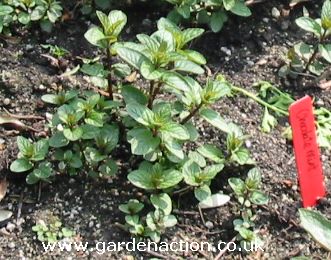
Chocolate mint
Mint suffers from only one disease and that is rust - allow it to get a hold and it will kill all your mint plants. There are chemical sprays for rust, but they can often be only a part solution. The best method is to examine each plant carefully for signs of rust (orange blobs generally on the underside of the leaves) and remove any leaves affected - spray as well with a chemical if you want. If this does not remove the infection chop the plant down to ground level and burn it all - drastic, but the only cure in the late stages of rust infection.

Recommended Mint Varieties
Spearmint Mentha spicata - a traditional mint for mint sauces. A strong grower with attractive dark green leaves.
Alpine Mint Bush Prostanthera cuneata - try something different, mint leaves with pure white flowers, a herb with true beauty.
Chocolate Mint - really does taste a bit like mint chocolate!. A novelty worth a try?